Agentic Testing vs AI-Assisted Testing: What Is the Difference?
Agentic testing vs AI-assisted testing: who acts, who decides, the risks of an AI agent that tests, and how to keep a test you can read and run again.
AI-assisted testing means AI helps a person with one task, such as suggesting a step or explaining a failure. Agentic testing means an AI agent gets a goal and plans, acts and checks by itself, then reports back.
Both words are used everywhere this year, often for the same feature. If you run a QA team, you need to know which one you are getting: a helper you stay in charge of, or an agent that works while you do something else.
What is AI-assisted testing?
Definition
AI-assisted testing is testing where a person does the work and AI helps with one task at a time.
- The AI suggests a step, proposes a check, reads a failed result or explains a difference.
- It never acts on its own.
The person starts every task and makes every decision.
What is agentic testing?
Definition
Agentic testing is testing where an AI agent is given a goal and works toward it by itself.
- It plans the steps, opens the application, acts on it and checks what happened.
- One request can cover creating a test, running it and reading the outcome.
The person sets the goal and reviews what comes back.
The word comes from agent: a program that takes several actions in a row, looks at the result of each one, and decides what to do next.
Agentic testing vs AI-assisted testing: the difference at a glance
AI-assisted testing
- You start the task
- You act on the app
- AI helps with one step: a suggestion or an explanation
- You decide, then start the next task
Agentic testing
- You give a goal
- The agent plans the steps
- The agent acts on the app
- The agent checks the result
- The agent reports back
- You review the finished work
| Question | AI-assisted testing | Agentic testing |
|---|---|---|
| Who starts? | A person, for each task. | A person, once, with a goal. |
| Who acts on the app? | The person. | The agent. |
| Who decides the next step? | The person. | The agent, until the goal is reached. |
| What do you review? | One suggestion at a time. | The finished work: a test, a run, a result. |
| What is the risk? | Small: a poor suggestion is refused on the spot. | Larger: many actions happen before anyone looks. |
| When does it fit? | A failed check to understand, a step to adjust. | A whole workflow to automate, a run to read for you. |
What are the risks of agentic testing?
An agent that tests by itself saves real time. It also raises three questions that a helper never raised.
Three risks come with an agent that tests on its own.
Who watches the agent?
An agent can take dozens of actions before a person looks, so a wrong turn early on shapes everything after it.
Can the run be repeated?
An agent that decides again at every run may take another path tomorrow, so a failure can be the agent and not your application.
Can anyone read the test?
And when the only record is a conversation, nobody can open the test, read its steps or say what it really checked.
If you cannot run it again without the agent, it was a demonstration, not a test.
The second risk has an article of its own: use AI to create the test, not to improvise every run.
What should you ask of an AI agent that tests?
One rule answers the three risks. Whatever the agent produces must be an ordinary test: one a person can open, read, change and run again without the agent.
| Ask | Why it matters |
|---|---|
| Can I open the test and read every step? | A test you cannot read is a test you cannot trust or repair. |
| Does it run again with no AI? | The same steps at every run give the same answer, so a failure means the app changed. |
| Was every check tried when it was made? | A check nobody tried can fail for ever, or pass whatever happens. |
| Does the agent ask before it changes a test? | What a test expects is your decision, not the agent's. |
| Can I choose the AI behind it? | Your screens and your data go where you decide. |
A longer list for a buying decision is in AI testing tools: 7 questions to ask before you choose one.
GUI Test Studio gives you both
GUI Test Studio automates end-to-end tests of any app without code, and it does not make you choose. It has an assisted side and an agentic side. Both end in the same place: a recorded test that a person owns.
| Kind | In GUI Test Studio | Who decides |
|---|---|---|
| AI-assisted | AI Smart Verification takes a second look at a failed check and explains the difference. | You read the explanation and choose what to do. |
| AI-assisted | AI Instructions tell the AI, in plain words, what to ignore or to watch on one check. | You write them. |
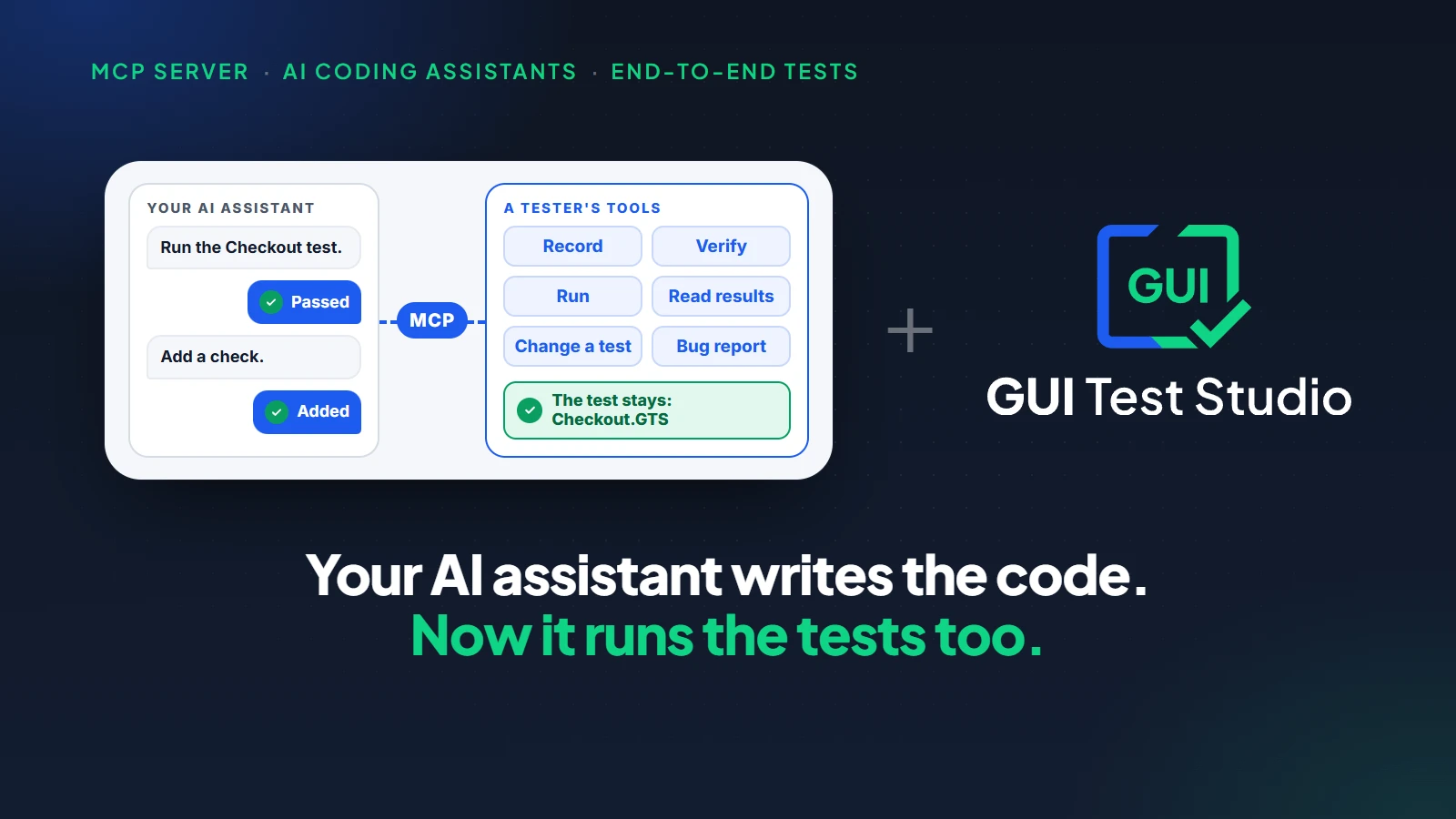
| Agentic | Your AI assistant creates a test from a prompt, runs it and reads the results. | You set the goal and review the test. |
| Agentic | The assistant changes a saved test in place. | It shows the change and asks before it writes. |
AI-assisted testing in GUI Test Studio: a second look at a failed check
When a check fails, AI Smart Verification looks at what was expected and at what the run found. It gives the final verdict on that check and says what differs in plain words, such as a changed word or a missing icon. It is optional, and it only looks at checks that failed.
A button's check keeps failing because the font got a little larger, which is fine for you. You add an instruction to that check: "Ignore changes to the font size, and the icon may be any colour." From then on, the AI follows your words each time it judges that check.
This is assistance in the strict sense: the AI explains, and you decide.AI Smart Verification shows where it is turned on and which AI it can use.
Agentic testing in GUI Test Studio: an assistant that creates, runs and reads
Through the connector installed with GUI Test Studio, an AI assistant becomes a testing agent. It works in Claude Desktop, Claude Code, ChatGPT with Codex and VS Code. It also works with a local AI model, one we provide or one you bring.
Create
A test from your prompt
Run
On the real screen
Read
What passed and failed
Change
After you confirm
You write: "Create a test for my app: add a client named Atlas Textiles, verify it is listed, then run it and tell me the verdict." The assistant opens the app, clicks and types for real, and tries each check on the screen before it keeps it. It saves the test, runs it, and tells you where the test is and whether it passed.
The agent works inside rules that keep you in charge.
- It does the workflow you asked for, and explores an app only when you ask it to.
- A check that could not pass on the screen is refused, so the test you get passes where it was made.
- Before it changes a saved test, it shows the change and waits for your answer.
- Accepting a new look or filing a Jira issue waits for you too.
How the connection works is explained in MCP server for testing, and every request you can make is in Create a test from a prompt.
What the agent leaves behind: a test that runs with no AI
This is the part that answers the three risks. The agent works once. What it leaves is a test file with its steps, its pictures and its recording.
The agent works once
- Opens the app
- Clicks and types for real
- Tries each check on the screen
- Saves the test
What stays with you
Clients.GTS
An ordinary test: its steps, its pictures, its recording
No agent needed to run it
Open the test on GUI Test Studio's timeline to read and change every step, like a video. Run it in GUI Test Runner-Recorder or in your pipeline. It replays by itself, the same steps in the same order, and no AI drives the application during a run.
| The risk | What answers it |
|---|---|
| Who watches the agent? | Every step it took is in the test, with the recording of the screen. |
| A run nobody can repeat | The test replays by itself. The same test on the same app gives the same answer. |
| A test nobody can read | The test opens on a timeline, step by step, without code. |
Where such tests fit when agents also write the code is in development with AI agents and in how to test AI-generated code.
You choose the AI: cloud, local or none
Assisted or agentic, the AI is a part you pick. Nothing ties your tests to one provider.
| Your choice | What it means |
|---|---|
| A cloud AI | The assistant your team already uses, and your own key for AI Smart Verification. |
| A local AI model | One we provide, or one you bring. Your request and your screen stay on your computer. |
| No AI | You record the tests yourself. They run and report exactly as before. |
In every case the tests, the recordings and the reports are files on your own computers.That is the subject of AI sovereignty in software testing.
What changes for the QA tester?
Agentic testing does not remove the tester. It moves the tester's time from clicking to deciding: which workflows matter, what each test must expect, and whether a failure is a bug or an intended change.
That shift is described in what a QA tester does when AI writes the tests.
What to know before you start
| Limit | What it means |
|---|---|
| The agent uses the real screen | Keep your hands off the mouse and the keyboard while it works. |
| A local AI model is slower | A local model, ours or your own, is best with short workflows. A cloud assistant creates long tests much faster. |
| A test checks what it was told to check | Say what must be true at the end of the workflow, or the agent has nothing to verify. |
Key takeaways
- 1AI-assisted testing helps a person with one task; agentic testing gives an agent a goal and lets it plan, act and check.
- 2The difference is who acts and who decides the next step, and so how much happens before a person looks.
- 3An agent's risks are a run nobody can repeat and a test nobody can read. Both come from an agent that leaves nothing behind.
- 4Ask for an ordinary test that you can open, read, change and run again without the agent.
- 5GUI Test Studio gives both kinds, with the AI you choose, and every test replays by itself with no AI.
Questions
What is the difference between agentic testing and AI-assisted testing?
In AI-assisted testing, a person does the work and AI helps with one task at a time. In agentic testing, an AI agent is given a goal and plans, acts and checks by itself, then reports back. The difference is who acts on the application and who decides the next step.
What is agentic testing?
Agentic testing is testing done by an AI agent that is given a goal. The agent opens the application, performs the steps, checks the results and reports back, without a person guiding each action. A single request can cover creating a test, running it and reading the outcome.
What is AI-assisted testing?
AI-assisted testing is testing where a person stays in charge and AI helps with single tasks. The AI suggests a step, proposes a check or explains why a check failed. The person starts each task and makes each decision.
Is agentic testing reliable?
It is as reliable as what the agent leaves behind. An agent that improvises at every run can take another path each time, so a failure may be the agent and not your application. An agent that records an ordinary test, which then replays by itself, gives the same answer at every run.
What are the risks of agentic testing?
There are three. An agent takes many actions before a person looks, a run that the agent decides anew each time cannot be repeated, and a test that only exists as a conversation cannot be read. All three go away when the agent's work ends in an ordinary test a person can open and run again.
Does agentic testing replace QA testers?
No. The agent does the clicking and the typing, and the tester decides what matters: which workflows to cover, what each test must expect, and whether a failure is a bug or an intended change. Those decisions cannot be handed to the agent.
Does a test created by an AI agent need the agent to run?
Not with GUI Test Studio. The agent creates the test once, and the test is then an ordinary file that replays by itself: the same steps in the same order, with no AI driving the application. It runs on your computer or in your CI/CD pipeline.
Which AI can I use for agentic testing with GUI Test Studio?
Claude Desktop, Claude Code, ChatGPT with Codex and VS Code connect in one click. A local AI model works too: one we provide, or one you bring. You can also use no AI at all and record your tests yourself.
Claude, ChatGPT, Codex, VS Code and Jira are trademarks of their respective owners.